Advancing cleanroom control: The proven value of 150mm settle plates & extended exposure

by |


by |
In the specialized field of aseptic manufacturing, compliant cleanroom airflow management requires precise, continual monitoring. While the industry continues to seek ways to balance microbial monitoring with the need for low-touch processes, Vetter developed a concept that does exactly that.
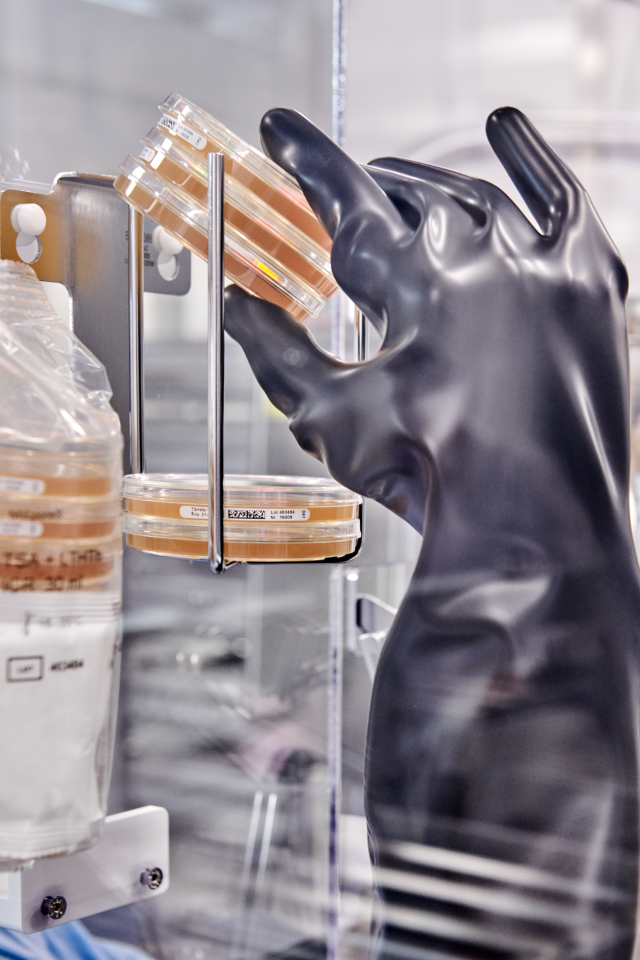
In our approach we’ve pursued the quality optimization strategy of equipping our clean rooms with larger 150mm settle plates and extending average exposure times to minimize human intervention in Grade A environments.
Recently published data has shown the efficacy of this approach.
Here’s a closer look at what we are doing to improve cleanroom control and the data that supports our efficient and proven approach.
For today’s aseptic manufacturers, cleanroom airflow monitoring programs must include precise, rigorous checks on personnel, surfaces, and the air. While regulators generally allow CDMOs to determine how they implement compliant testing in their Grade A environments, they must use methods that minimally disrupt the unidirectional airflow (UDAF) essential to sterility.
Most organizations, including Vetter, utilize an approach that combines two different techniques:
By enabling precise microbial monitoring with minimal UDAF disruption, passive monitoring with settle plates has become the standard for continuous air monitoring. But settle plates nonetheless pose a challenge: due to technical and regulatory reasons, they must be changed frequently, leading to inevitable contamination risk with every replacement.
Historically, the industry has relied on 90mm settle plates with allowable exposure times between 4 and 5 hours. While these parameters comply with key regulations, including EU GMP Annex 1 9.30 and USP <1116>, they require up to 6 exchanges in a 24-hour filling cycle. To address this challenge and protect product quality, Vetter adopted and validated a different testing approach — one that enables us to maintain compliant test sensitivity while reducing exchange frequency by up to 50%.
Our clean room management strategies have prioritized the use of 150mm settle plates. While adoption was initially supported by a clear testing advantage with a sampling surface 2.3X larger than standard plates we also believed that this larger surface area could sustain sensitivity over longer periods, extending both exposure time and exchange windows.
To support the highest possible quality standards, we rigorously evaluated this hypothesis in conditions representing the stresses of real-life clean room conditions. Our microbiology experts looked closely at four key parameters:
The answers collected through their evaluation confirm the results. Larger plates can be exposed to UDAF for substantially longer periods of time without reducing test sensitivity below compliant levels, even in the peak stress of low-humidity environments.

Our experts’ assessment compared growth on unstressed plates against those exposed to the environmental stress of UDAF. The test set included a variety of established reference organisms and various Vetter in-house isolates, chosen specifically to represent the challenging conditions of a cleanroom environment.
In a simulated cleanroom environment with moderate humidity (35%-45% RH), recovery rates consistently met the 50%-200% acceptance criteria at two different exposure times:
For the full picture and to rule out any uncertainties, our specialists simulated both early and late contamination events at both exposure times:
With larger settle plates, our evidence showed, extended exposure times and minimized exchange rates are both possible for compliant clean room management strategies — at least in the moderate humidity levels typical of most Grade A environments. But one key question remained: Could our 150mm plates also sustain their sensitivity under even drier conditions?
While most cleanrooms operate at 35%-45% RH, cleanrooms dedicated to lyophilized products are typically set to very low humidity (< 10% RH). Because low humidity accelerates agar dehydration, we performed a special stress test to ensure our plates remain their suitability in even these most extreme cases, using plates exposed to real-world, low-humidity UDAF clean room conditions for 6 hours.
Following post-exposure inoculations, these plates still delivered robust recovery rates between 66% and 150% confirming no negative effect on growth. Dehydration of agar plates after 6 hours at very low humidity was comparable to that observed after 8 hours at moderate humidity. Plates in the low-humidity environment lost on average of about 24% of their water content.
Perhaps most importantly, this data validates our approach: 150mm settle plates can maintain compliant sensitivity for up to 8 hours in moderate humidity or 6 hours in low humidity, enabling us to substantially reduce both exchange frequency and contamination risk. By safely extending exposure time, we’re able to keep interventions to a minimum, reduce the overall microbial risk during aseptic filling and support the highest possible quality levels.
Therefore, our proven concept supports the safety of our customers' products during the manufacturing process, reduces risks and reinforces the stability and quality of modern production strategies.